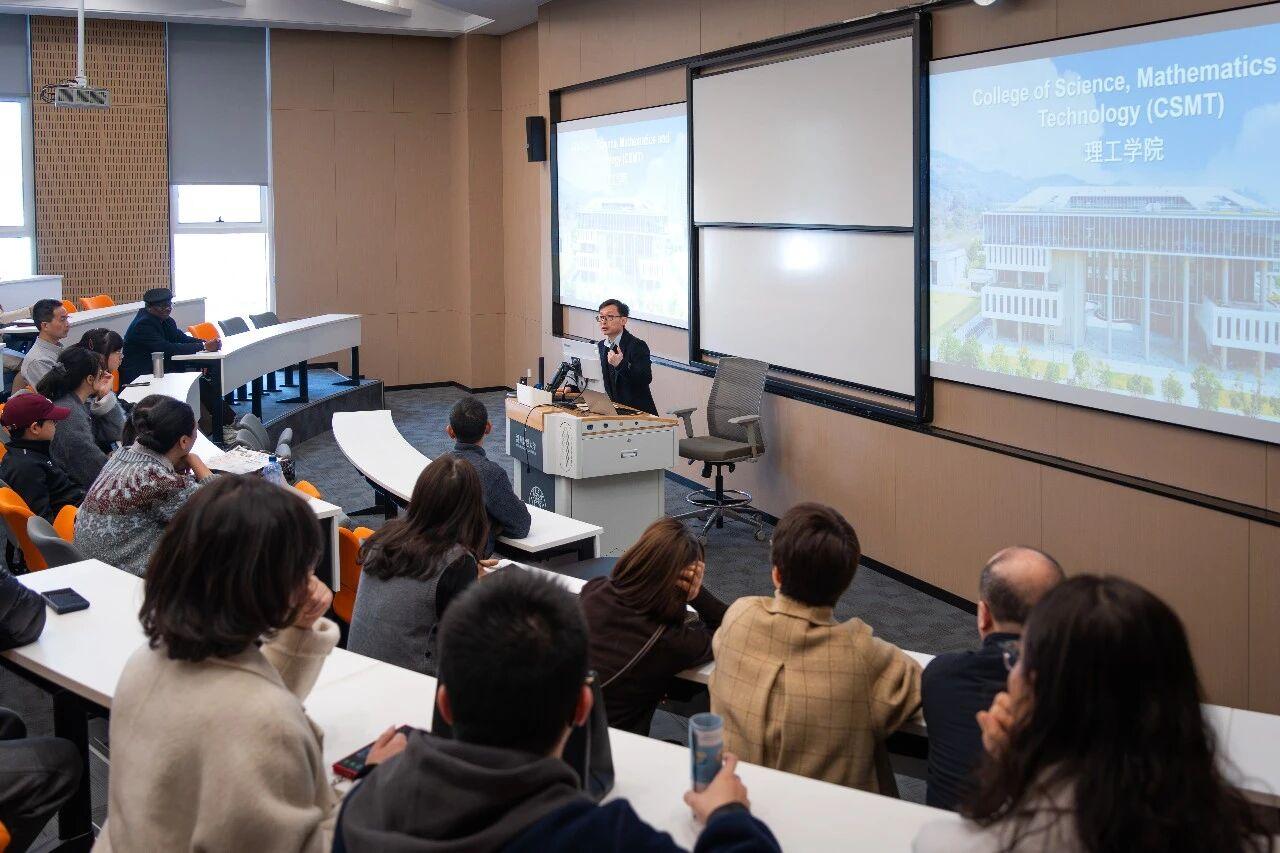
Psychology Workshop | Series of Sharing Sessions on Psychology Empowering Technology and Career Development
Recently, a series of psychology sharing sessions with the theme of "Psychology Empowers Technology and Career Development" has been hold at WKU Library Academic Seminar (SLAC 607). The activity invited Dr. Christopher Cole, a quantitative user experience researcher, and Dr. Irene Lin, a cross-disciplinary research expert, to lead students in reflecting on how psychological thinking and frameworks can bring new value to career development, from academic research to industry practice.
The Academic Seminar in SLAC 607 of WKU Library is a long-term activity space open to faculty and students. If you need to make an appointment for an activity, please send an email to lib_events@wku.edu.cn.
Now let's review the workshop activity.
Guest Profile
Dr. Christopher Cole is a Quantitative User Experience Researcher at Meta, where he applies experimental psychology and advanced statistical methods to optimize digital products. With extensive experience at Meta, Apple, and Google, he specializes in survey design and data analysis, transforming behavioral insights into effective product strategies.
Dr. Irene Lin has over 15 years of experience across both industry and academia—from global corporations to agile startups. She firmly believes in and practices applied research to create meaningful, user-centered solutions. Grounded in psychology, her work spans fintech, social services, retail, and healthcare, all shaped by an inclusive, cross-cultural perspective that drives innovation and empathy in practice.
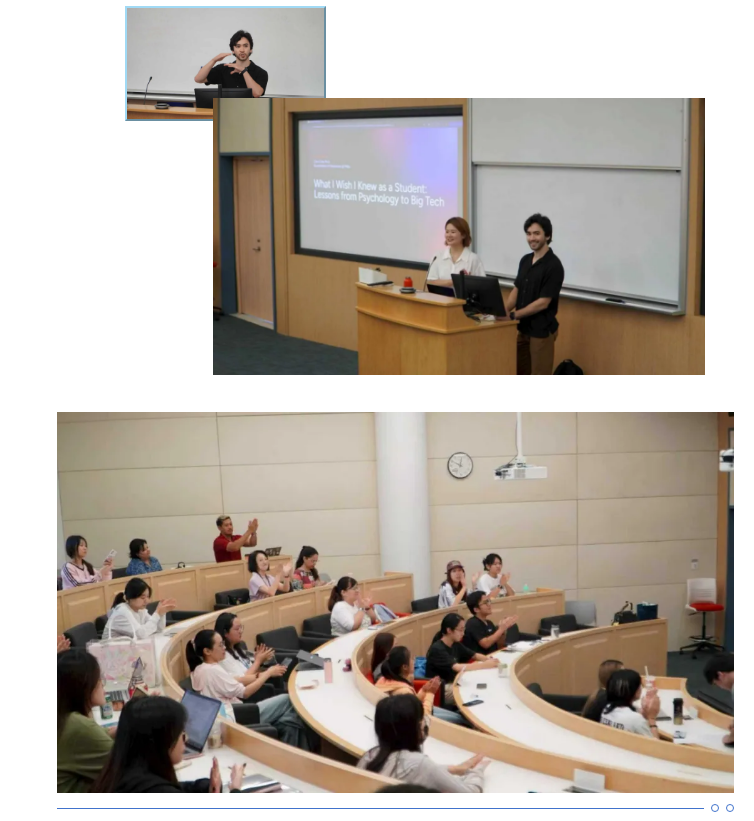
“What I Wish I Knew as a Student: Insights from Psychology to Big Tech” — Dr. Cole’s Talk
Lesson 01|Your Degree Is a Launchpad, Not a Limit
He shared that fields like psychology, sociology, and education all train us to understand people, think about behavior, and analyze complex systems—skills that apply to any industry. After joining a tech company, he realized that what he had learned—statistics, experimental design, and behavior analysis—were exactly what product teams needed most.
Think back to three things you do best in your coursework—whether it’s designing surveys, analyzing data, or explaining findings. Then look at real job descriptions, and you’ll see that what you’ve practiced in class has already become the foundation for your career. Your major isn’t the finish line—it’s where your understanding of the world begins.
Lesson 02|Translate Academic Skills Into Career Value
Employers care less about the degree you hold and more about what you can do. What matters is translating academic training into real-world impact—showing results, not just methods.
The ability to design studies in academia becomes the ability to design experiments and test product features in industry. Analyzing data in papers turns into measuring business outcomes. Writing clear academic arguments becomes telling compelling, insight-driven stories. Presenting in the lab becomes presenting confidently across teams.
Take your last research project— maybe a thesis, class experiment, or lab study—and rewrite it in three sentences: the goal, what you did, and what you learned. Drop the jargon. That short summary is the beginning of your professional story.
Lesson 03|You Have More Career Paths Than You Think
As a student, his biggest anxiety was not knowing what to do after graduation. Later, he realized there were far more paths than he imagined.
Some psychology graduates use experimental design and behavioral analysis to improve user experiences. Others apply motivation and decision-making psychology in marketing and consumer insights. Some turn complex datasets into trends and predictions, while others use organizational psychology and survey design to help companies hire and develop talent better.
A background in psychology builds powerful transferable skills—the ability to understand people, systems, and experiments.
Lesson 04|Relationships Create Opportunities
Research shows that 50%–80% of job opportunities come through networking. Growth often stems not from a perfect résumé, but from genuine curiosity and human connection. Mentorship accelerates progress, and curiosity is stronger than any “networking script.”
You don’t need a huge network—just the courage to start a conversation. Reach out to an alum or professional with a simple message:" Hi, I’m a psychology student exploring research careers. I saw that you [insert observation], and I’d love to ask two quick questions about your path.”
Real opportunities often begin with one sincere conversation.
Lesson 05|Keep Learning and Stay Open
New tools, new ways of thinking, and new challenges are always emerging. What matters most isn’t what you already know, but what you’re still willing to learn. His background in psychology helps him stay curious—about people, change, and the unknown.
It’s this small and consistent curiosity that fuels continuous growth and transformation over time.
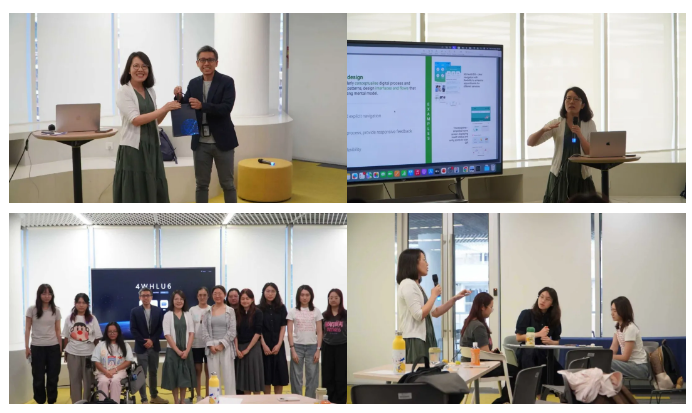
“Integrating Design Thinking and Research Tools to Solve Complex Real-World Problems” — Dr. Lin’s Workshop
1. Methodology: Bridging Research and Design
Dr. Lin introduced a systematic research process covering the five key stages of usability testing—recruitment, preparation, testing, analysis, and reporting—highlighting how methodological rigor ensures meaningful and reliable results.
She also discussed the diversity of research tools, from moderated and unmoderated tests to guerrilla testing, A/B testing, and focus groups, illustrating their different use cases.
Through a contextual inquiry of a “Scan & Go” supermarket case, she demonstrated how interviews and observations can uncover design issues—such as customers often ignoring the self-checkout signage and heading straight to the staffed counters.
2. Practice and Application: Hands-On Design Sprint
The workshop featured a two-hour design sprint, where students experienced the full journey from challenge to prototype. Each group selected real-world topics—such as making self-driving cars accessible for people with disabilities or encouraging healthy eating habits—and applied rapid ideation methods like Crazy 8s followed by clustering and voting to finalize their prototype concepts.
This hands-on process allowed participants to deeply understand how research insights can directly inspire innovation and transform abstract ideas into concrete solutions.
3. Research Empowerment and Future Outlook
The session concluded with a discussion on the strategic role of UX research in organizations, spanning from macro-level market and strategy insights, to meso-level contextual and user needs exploration, down to micro-level experience optimization.
Dr. Lin also introduced an evolving research toolkit, from traditional qualitative methods to modern AI-assisted platforms such as UserTesting, Maze, and ChatGPT. She emphasized the importance of researchers’ ability to craft compelling data-driven stories through these tools, empowering innovation in the age of intelligent research.
“From Lab to Industry: Turning Psychology into an Impactful Career” — Dr. Cole’s Workshop
1. Applying Psychological Principles
Dr. Cole shared how psychology provides a powerful foundation for real-world problem-solving: understanding users’ true needs, designing and evaluating experiments and surveys, interpreting data and human behavior, and communicating insights clearly to teams and decision-makers.
Psychology teaches us to make decisions grounded in evidence and human needs—a core capability that drives organizational growth. By leveraging empathy and communication, we can bridge the gap between diverse stakeholders and align research insights with strategic goals.
2. Career Pathways
•User Experience Research
Apply cognitive and social psychology to understand user behavior and design more human-centered products. Use experiments and usability testing to validate design outcomes. Possible roles include User Experience Researcher and Human Factors Engineer.
Key areas of study: research methods, data analysis, psychology, and behavioral science. Gain practical experience through lab projects or internships.
•Data Science and Analytics
Combine analytical thinking and statistical skills to interpret data scientifically. Typical roles include Data Analyst and Data Scientist.
Key areas of study: statistics, data analysis, and programming (R, SQL, Python). Strengthen practical ability through projects and competitions.
•People Analytics / Human Resources
Apply organizational psychology and behavioral science to improve recruitment, training, and performance management. Potential roles include HR Analyst and Organizational Psychologist.
Key areas of study: organizational psychology, statistics, and organizational behavior. Build experience through internships or applied research projects.
3. From Research to Practice: Academic CV vs. Industry CV
•Academic CV: highlights depth of research—education, publications, teaching, and grants—with a formal and detailed structure.
•Industry CV: emphasizes skills and outcomes—summary, experience, skills, education—in a concise and results-oriented format.
Keywords:
Use academic verbs such as investigated, published for research contexts; use improved, launched for industry achievements.
The STAR Framework
•Situation: Describe the context.
•Task: Define the goal or challenge.
•Action: Explain the steps you took.
•Result: Highlight the outcomes achieved.
Resource | WKU Psi Chi
Review | REN Yuanyuan & TANG Lianyi